In the gentle morning light of Nooropolis, as the city awakens to the soft murmur of Fajr, we often find ourselves captivated by the smallest members of our community: our toddlers. Their eyes, wide with wonder, mirror an innocence so profound, a potential so vast, it humbles the soul. What seeds do we plant in these nascent hearts? What pathways do we illuminate for their tiny feet? For us, as stewards of this blessed community, the answer lies in Akhlaq – the cultivation of noble character, sown patiently and lovingly from the very dawn of life. This is not merely about teaching rules; it is about sculpting souls, building an inner sanctuary of virtue that will guide them through every whisper and storm of existence.
The Divine Blueprint for a Virtuous Child
Our beloved Prophet Muhammad, peace be upon him, encapsulated the very essence of his mission when he declared, “I was sent to perfect good character.” This profound statement, echoing through the annals of time, serves as our foundational blueprint for parenting. In Islam, character is not an accessory to faith, but its very bedrock. Akhlaq is the outward manifestation of iman – our inner conviction in Allah. For our toddlers, whose minds are sponges and whose spirits are untainted canvases, this means integrating Quranic principles and Prophetic teachings into their daily tapestry, not as abstract doctrines, but as lived experiences. Before they grasp the complex nuances of theology, they can embody kindness, share a toy, or offer a gentle touch. This early immersion in virtue fosters a deep sense of accountability to Allah, to themselves, and to their community, nurturing hearts predisposed to service and goodness. It is in these tender years, between one and three, that we lay the groundwork for a personality that is not just successful in this world, but eternally blessed in the Hereafter.
Seeds of Goodness: Key Islamic Values for Toddlers
To nurture these budding souls, we focus on specific values, drawn directly from the wellsprings of Islamic wisdom. These are not abstract concepts for toddlers, but simple, tangible habits that begin to shape their identity and moral compass.
Kindness and Compassion
Central to the tapestry of Akhlaq is the luminous thread of Kindness and Compassion. Our Prophet ﷺ, the ultimate embodiment of mercy, showed unparalleled tenderness towards children, the poor, and even those who wronged him. This profound example teaches us that empathy is not an innate trait for some, but a muscle to be flexed and strengthened from infancy. For our toddlers, this translates into gentle touches, comforting a crying playmate, or sharing a snack. We nurture this by modeling tenderness in our voices, patience in our interactions, and generosity in our actions.
Honesty and Integrity
From the simple act of admitting to a broken toy to understanding the importance of keeping a promise, Honesty and Integrity form the backbone of trust. Even at this early age, we can begin to plant these seeds. We reward truthfulness with affirmation and gentle explanations of why telling falsehoods can hurt others. Simple stories can illustrate the beauty of truth. Allah admonishes us in the Quran, “O you who have believed, fear Allah and be with those who are true” (Surah At-Tawbah 9:119). Our role is to create an environment where honesty is always the safest and most celebrated path.
Respect
The concept of Respect is vital, beginning with the sanctity of the family unit. Toddlers learn respect primarily through observation. When they witness us speaking with reverence to our parents, listening attentively to elders, or engaging respectfully with teachers and community members, they absorb these cues. It’s about teaching them to greet others with a cheerful ‘Assalamu Alaikum,’ to use polite words like ‘please’ and ‘thank you,’ and to understand that every individual, regardless of age, deserves dignity and consideration.
Sharing and Responsibility
The bustling world of a toddler is often centered on ‘mine!’ Yet, this is precisely where we can introduce Sharing and Responsibility. Through play, we encourage them to offer a toy, pass a snack, or take turns. These seemingly small acts are powerful lessons in selflessness and community. Linking these habits to spiritual practices, even implicitly, can be profound. Just as Salah instills discipline through daily routines, so too can tiny responsibilities around the home, like putting away toys, instill a sense of order and contribution, fostering a budding understanding that their actions impact others.
Patience (Sabr) and Resilience
Life, even for a toddler, presents its small frustrations: a block tower tumbles, a desired toy is out of reach. These are not merely moments of irritation, but invaluable opportunities to cultivate Patience (Sabr) and Resilience. We introduce the concept of Tawakkul – trusting in Allah – by reassuring them that some things take time, or that a temporary setback is not the end. The Quran frequently emphasizes steadfastness in trials, reminding us, “For indeed, with hardship [will be] ease. Indeed, with hardship [will be] ease” (Surah Al-Inshirah 94:5-6). We teach them to take a deep breath, to try again, and to understand that perseverance, coupled with faith, yields beautiful fruits.
Modesty and Humility
Finally, in a world often driven by self-promotion, the quiet virtues of Modesty and Humility are more crucial than ever. For toddlers, this begins with simple concepts: being gentle, not boasting about achievements, and understanding that all blessings come from Allah. We share stories of the Prophet’s ﷺ profound humility – how he mended his own clothes, ate simply, and never sought excessive praise. These narratives, even in simplified forms, paint a picture of inner strength that doesn’t need external validation, fostering a serene confidence rooted in gratitude rather than arrogance.
Playgrounds of Piety: Practical Strategies for Tiny Hands and Hearts
Understanding the values is one thing; bringing them to life for our energetic toddlers is another. Their world is one of discovery through interaction, and our strategies must reflect this dynamic spirit. We transform lessons into joyful engagements, adapting to their short attention spans and boundless energy.
Playful Activities and Games
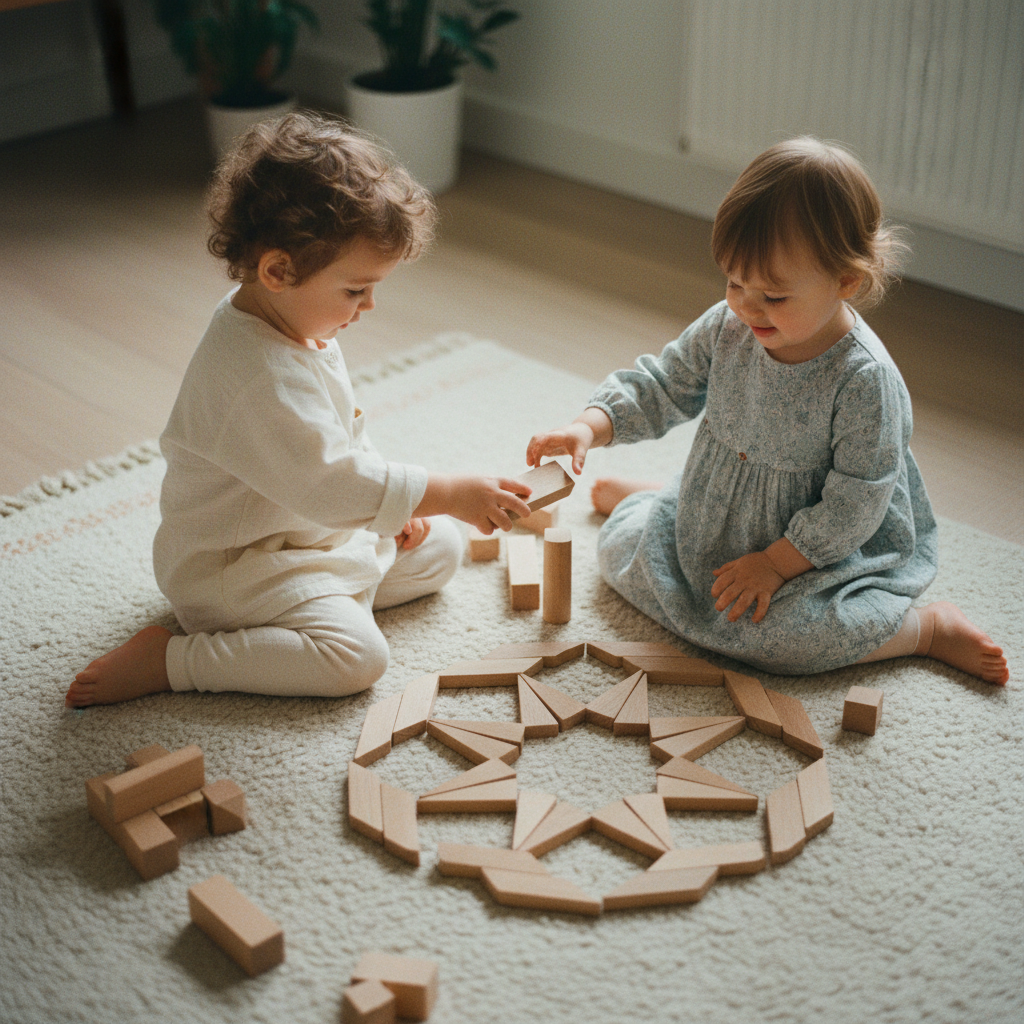
The most potent classroom for a toddler is play. Turn lessons into games! Use building blocks to teach sharing, where each child adds a piece to a communal tower, or practice taking turns with a favorite toy. Simple role-playing games where a doll needs comfort or a toy animal is ‘hungry’ can subtly introduce empathy and caregiving. These active learning moments allow children to internalize concepts through doing, rather than just hearing.
Islamic Moral Stories
Our rich Islamic heritage is brimming with tales of Prophets, their companions, and righteous individuals whose lives exemplify the very values we wish to instill. Picture books illustrating the Prophet Muhammad’s ﷺ empathy towards an orphan or his kindness to animals can captivate young minds. Keep these sessions brief – under five minutes – using expressive voices and engaging visuals. Re-tell simple anecdotes of Abu Bakr’s honesty or Aisha’s generosity. These stories are not just entertainment; they are windows into a virtuous past, shaping a hopeful future.
Role-Playing and Modeling
Children are master imitators. This makes parents and educators the primary role models. When we embody kindness, patience, and respect in our daily interactions, our children absorb these traits naturally. Role-playing scenarios, such as how to resolve a conflict over a toy or how to offer comfort to a friend, provide a safe space for toddlers to practice appropriate responses before real-life situations arise. Our actions speak volumes far beyond our words.
Daily Routines Infused with Purpose
Structure and routine provide comfort and predictability for toddlers. We can integrate Akhlaq into these routines. Simple daily prayers (Salah), even if only observing or mimicking the movements, instill a sense of discipline and connection to the Divine. Designate a ‘kindness moment’ where everyone offers a compliment or a small act of service. Establish rituals for recognizing good behavior – a special hug, a verbal affirmation, or a sticker – reinforcing positive choices.
Group and Service Play
Toddlers are nascent community members. Encourage “community service” at their level. This could be helping to put away toys with siblings, passing out napkins at mealtime, or watering a small plant. These simple group activities foster teamwork, a sense of belonging, and the understanding that contributing to the well-being of others is a joyful responsibility, laying the groundwork for greater acts of service in adulthood.
Consistent Home Reinforcement
The home is the first school. Creating a nurturing environment requires consistency. This means short, manageable schedules, utilizing free online resources for Islamic stories or songs, and showering encouragement for every tiny step taken towards good character. Assign tiny, age-appropriate ‘Quran portions’ – perhaps listening to a short Surah or repeating a single ayah with its simple meaning – connecting their budding spirituality to daily life. It’s the continuous, gentle reinforcement that molds lasting habits.
The Village of Virtue: The Collective Responsibility
The journey of cultivating a virtuous heart in a child is not a solitary path; it is a collective endeavor, a sacred trust shared by parents, educators, and the entire community. In Nooropolis, we understand that our children are the architects of our future, and their character is the foundation upon which that future will be built.
The Power of Example: Parents and Educators as Living Role Models
The most profound lesson a child receives is not from what we say, but from what we do. Parents are the child’s first teachers, and their actions are the most impactful curriculum. When a parent demonstrates patience during a difficult moment, offers forgiveness, or speaks with gentleness, these virtues are absorbed far more deeply than any lecture could convey. Similarly, educators in our Islamic schools and madrasahs bear a weighty responsibility. They are not merely transmitters of knowledge, but living examples of Islamic Akhlaq, complementing and reinforcing the lessons learned at home. A united approach, where both home and school consistently uphold and celebrate the same values, multiplies the impact exponentially, weaving a seamless tapestry of moral guidance around the child.
A United Front: Home, School, and Community
Imagine a child who learns about kindness at home, sees it reinforced by their teacher, and observes it in the interactions within their community. This cohesive environment provides a powerful, consistent message that good character is not an option, but an expectation, a way of life. Regular ‘character sessions’ based on Quranic teachings and Prophetic wisdom, adapted for young minds, can be implemented both in educational settings and within family circles. These sessions can explore a value each week, using stories, crafts, and discussions to embed the principle deeply.
The Investment in a Lifetime of Good
Starting this journey of Akhlaq at the toddler stage is perhaps the most significant investment we can make in our children’s lives. It equips them not just with a moral compass, but with the inner strength to navigate life’s inevitable challenges, to distinguish right from wrong, and to stand firm on principles. A child raised with a deep understanding and embodiment of kindness, honesty, respect, patience, and responsibility is poised to become a compassionate leader, a trustworthy friend, a righteous community member, and a sincere servant of Allah. They are not just developing good habits; they are forming an identity rooted in faith and virtue, ready to contribute meaningfully to the world, embodying the very spirit of Nooropolis as a beacon of Islamic excellence and human flourishing.
The tiny hands that reach for ours today will one day build the mosques, write the books, innovate the technologies, and lead the communities of tomorrow. The purity of their hearts, if nurtured with the divine light of Akhlaq, can illuminate the entire world. Let us, then, embrace this sacred trust with diligence and devotion. Let us be the living examples, the patient storytellers, the joyful playmates, and the unwavering guides on this path of virtue. For in raising kind hearts in our toddlers, we are not just shaping individuals; we are cultivating a generation rooted in faith, radiating compassion, and poised to carry the banner of goodness high, ensuring that Nooropolis, and indeed the world, continues to be blessed with the profound beauty of perfected character. This is our legacy; this is our hope; this is our prayer.